
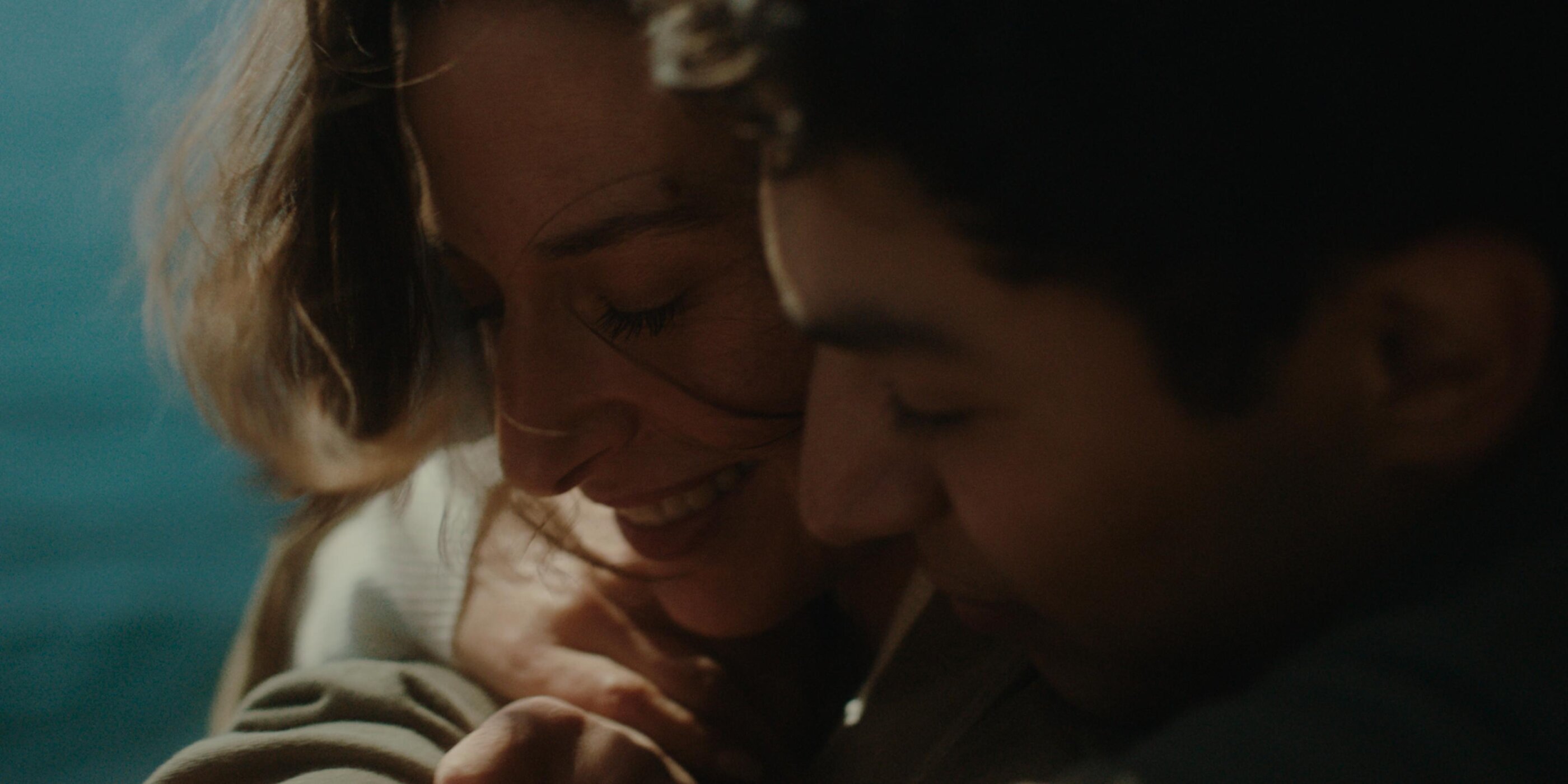
Norwegian director Nina Knag’s debut feature, Don’t Call Me Mama, which has world-premiered in the Crystal Globe Competition at the Karlovy Vary IFF, explores the gradual erosion of personal and gender boundaries. Don’t Call Me Mama examines the fragile interplay of power, desire and vulnerability in an intimate character study of a middle-aged woman whose sexual reawakening through a relationship with a young refugee gradually exposes the fault lines between personal impulses and institutional roles.
At the centre is forty-something Eva (Pia Tjelta), a literature teacher and the wife of the local mayor, Jostein (Kristoffer Joner), who forms an unexpected bond with 18-year-old Amir (Tarek Zayat), a refugee with a talent for poetry, who arrived not long ago. Initially framed as a story of emotional dislocation within the stagnant marriage of Eva and Jostein, the story pivots towards a discreetly drawn, morally ambivalent relationship that challenges traditional gender notions of desire and agency. The screenplay, co-written by Knag and Kathrine Valen Zeiner, exposes the complicated power dynamics at play, even though Don’t Call Me Mama is not Lolita in reverse.
Knag’s debut unfolds amidst a well-balanced shift in genre and tone, beginning as a restrained marital drama before transitioning into a story of forbidden romance between the woman and the refugee. What initially appears to be a story of emotional and sexual reawakening gradually takes on the contours of a psychological drama, as Eva’s projection of desire and unmet needs edges into obsession and self-deception. As the affair crumbles for different reasons, the film turns into a social chamber thriller, which nonetheless steers clear of melodrama, marked by Eva’s growing paranoia and escalating personal risk. The consequences of the affair, threatening her social standing and Amir’s asylum status, are rendered with increasing tension, underlining the political and personal stakes of a liaison conducted across generational, institutional and cultural lines.
Shot by Alvilde Horjen Naterstad, the cinematography adopts a naturalistic visual register, favouring tight framings and subdued lighting to mirror Eva’s increasingly claustrophobic emotional state. The camera remains closely aligned with her perspective, reinforcing the film’s intimacy while avoiding overt stylisation. Static compositions are employed to isolate characters within domestic and institutional spaces, reflecting the underlying tension between personal desire and social conventions.
Read the full review here.